Bugatti plan new 1500 hp Hybrid with axial flux motor & electric turbos

Autocar report that a new Bugatti Veyron is currently undergoing initial conceptual engineering tests in a programme aimed at unveiling the car in 2016 prior to a planned start to customer deliveries the following year. According to sources close to Bugatti, early test 
mules for the new car exist 
and have already been 
pressed into action in an 
early round of testing.

“Five developmental prototypes with differing powertrain combinations have been constructed up to now,” said one insider. “They are based on the existing car 
but use various solutions 
that are being considered for the new model.”

Following recent arrivals such as the McLaren P1, Porsche 918 Spyder and LaFerrari, the new Bugatti will feature a battery powered hybrid electric powertrain. The same quad-turbocharged 8.0-litre W16 powerplant as 
its predecessor will be retained but with the possible addition of electric turbochargers, perhaps along the lines of those used by Porsche in LMP1 (Porsche and Bugatti are both part of the VW group) and the 2014 Formula One ERS MGU-H (where the H stands for heat).

The big news centres around plans to provide the new Bugatti with hybrid drive by way of a disc-shaped Axial Flux electric motor mounted within the gearbox housing. Together, the petrol engine and electric motor are said to deliver up to 1500 hp. By comparison, the Veyron Super Sport has 1183 hp.

Autocar sources suggest that torque will be capped at 1500 Nm for the sake of gearbox reliability. A Veyron Super Sport already has 1500 Nm from 3000 to 5000 rpm. With an Axial Flux AC Induction motor able to generate almost as much torque (1250 Nm from the EE in-wheel motor) The Bugatti hybrid electric powertrain design looks like a very conservative step with full potential limited by the fragility of it's mechanical driveline.

The new hybrid Veyron should have some fairly startling performance in electric only mode (if it has one - see LaFerrari), but in parallel mode, other than providing torque fill below 3,000 rpm, (partly explaining why Bugatti expect 0-100 km/h times to drop to 2.3 sec) the full potential of the hybrid powerplant will be restricted by a mechanical transmission layout that may not have moved on much from the current Veyron.

As with the McLaren P1, a hybrid that still idles in traffic, or the LaFerrari which has no pure EV mode, the new Bugatti may succeed in combined the superior low rpm torque characteristics of an electric motor to give the instant throttle response and acceleration of an EV, what McLaren call 'torque fill', with the enormous top end torque of a large displacement forced induction ICE, but in common with the aforementioned hybrid hypercars, it may be very much a first generation mild hybrid.

As Bugatti are testing five prototypes with differing powertrain combinations perhaps there are some surprises still in store. With an expected sales date in 2017 the new Veyron should be much father down the road technically than either the McLaren of LeFerrari. The current cutting edge is represented by the Mercedes SLS E-Drive with it's wheel motor powertrain allowing full blown dynamic torque vectoring to amazing effect.

In fact it was a Mitsubishi developed wheel motor powertrain with S-AWC (Mitsubishi brand for torque vectoring) that recently re-set the record books at Pikes Peak finishing 2nd and 3rd outright with only one ICE powered car preventing an EV clean sweep in 2014.

Is it too much to hope for a Bugatti with torque vectoring or will we have to wait for future evolutions of hybrid supercar powertrain design before we see anything truly revolutionary.

Blog, Updated at: 10:39 PM

BMW-Toyota sports car to use all-wheel drive and supercapacitors

BMW's newly minted alliance with Toyota will result in a hybrid all-wheel-drive Z4 / Supra replacement, complete with supercapacitor technology for increased performance, Autocar reports.

The car will have a front-engined direct-injection four cylinder turbo and electric motors driving all four wheels. The supercapacitor system will be derived from technology first seen in Toyota's Hybrid Supra HV-R in 2007 when it won the Tokachi 24 hour race and more recenly Toyota's Le Mans LMP1 race cars.

BMW will supply the 2.0 liter turbocharged engine combined with electric motors produced by BMW at its engine plant in Munich while a Toyota-developed electronics system is expected to provide torque-vectoring capability.

With the car expected to have a front mounted engine and sequential manual gearbox in a conventional longitudinal powertrain layout it will be interesting to see what type of electric motors BMW deploy to drive the front wheels, perhaps in-wheel motors as speculated back in 2010?

Blog, Updated at: 8:00 AM

EVDrive Demo a UTV with 4-Wheel Motor Torque Vectoring [VIDEO]

EVDrive completed development and demonstrated a powersports industry first, an "electric 4-wheel 4-electric-motor torque vectoring technology" called Terra-Torque-Drive™, specifically geared to 4-wheel off-road powersports vehicles, such as for the rapidly growing market segment of side by side Utility Terrain Vehicles or UTVs. After taking recent demo rides in the EVDrive-UTV tech demonstrator, powersports industry insiders, such as UTV OEM reps and UTV racers enthusiastically agree, that the Terra-Torque-Drive™, technology would beat almost all of today's top "gas/mechanical powered" 4wd UTVs. OEMs now have the opportunity to license this unique technology for integration into their own future powersports side by side UTV vehicle offerings.

Approximately 323,000 UTVs were retailed in North America in 2012, according to Power Products Marketing (PPM), a market research firm. PPM found consumer models (for example: Polaris RZR XP900) accounted for around 35% of total sales; Prosumer models (example: Deere XUV825i) garnered around 55% share, and commercial models (example: Bobcat Toolcat) were responsible for about 5% of sales. Industry insiders concur that the new EVDrive technology could apply to all 3 market segments. Compared to the top UTVs sold today, a Terra-Torque-Drive™, powered UTV with EVDrive Range Extender (REX) installed would excel in these areas:

1 - Highest efficiency 4wd drivetrain on any UTV today (least mechanical losses)
2 - Adjustable hill descent control (accomplished via an "electric engine braking" called "regen" putting energy back into the vehicles battery system from each of the 4 wheels)
3 - Dynamic torque vectoring modes both for high and low speed operation, e.g. industry unique "Zero Radius Turning" and high speed active torque vectoring allows for better and safer handling off-road
4 - Torque and power from -100 to +100% can be dynamically sent to any wheel, in either direction, in any combination, at any time.
5 - True Series hybrid with optimized internal combustion engine powered REX to allow for longer range matching or exceeding gas powered UTVs sold today. (REX is a high voltage specialized generator- LPG, gas or diesel powered REX engine easily adaptable, no mechanical connections to vehicle)
6 - 120vac power from onboard battery pack, backed up with the REX for general utility use
7 - Lower cost to maintain and operate - superior fuel economy, estimated average 50-100% better – for short trips, no fuel may be needed at all – plug-in to standard electric car chargers.
8 - Superior straight-line and rough loose material, curvy trail acceleration
9 - Greater river depth traversal possible due to completely sealed liquid cooled e-motors/power electronics.
10 - Stealthy low noise operation in electric only mode e.g. wildlife observation & hunting
11 - Torque vectoring software platform allows new traction capabilities to be supported like "apps" without costly mechanical NRE expenses to the OEM – OEM can provide customers software updates for new capabilities.

EVDrive chose the 4-seat Kawasaki Teryx4 as a tech demonstration platform because of its short wheelbase, smaller turning radius, and large break over angle to minimize getting hung up on obstacles. EVDrive modified this UTV with complete removal of the gas engine and AWD mechanical drivetrain and replaced with a 160hp peak total version of the Terra-Torque-Drive™. Unlike the stock Kawasaki Teryx4 UTV mechanical AWD drive, no additional mechanical losses are incurred in the Terra-Torque-Drive™, regardless of AWD mode from lack of transmission, driveshafts and differentials. "Off-road UTVs are ideally suited to our torque vectoring technology where only single fixed speed reduction is required per motor-wheel to attain 55-75mph top-speeds with the type of high RPM brushless motor technology we employ," said COO, co-founder, Steve Tice.

The Terra-Torque-Drive™, is a customized version of the general and modular EVDrive-Train architecture™ (http://bit.ly/EVD-Arch) used on all EVDrive conversion projects, with an in-house developed scale-able torque vector software platform added running on the EVDrive VCU (vehicle control unit), which supports new traction modes with inputs from all driver controls plus vehicle sensors such as accelerometers, etc. Some planned traction modes, that go beyond what is currently running on the demonstrator: auto dynamic terrain type posi-traction control, variable inclination angle offset descent control, zero radius turns on incline, emergency 4-wheel panic braking/stop & boulder climbing.

The Terra-Torque-Drive™, powered e-UTV demonstrator uses 4 of the sealed liquid-cooled EVDrive EVD35 35kW/47HP peak drive sub-systems, de-tuned to ~30kW/40HP each or delivering a total of ~160HP/120kW peak. At each motor shaft, ~66 ft-lbs peak torque is delivered. The 4 gearboxes allow ratio changes with off-the-shelf gearsets. With the currently installed single speed gearsets, at the CV joint of each wheel, a whopping 726 ft-lbs peak torque is delivered. This is the kind of torque necessary to perform Zero Radius Turns with a fully loaded vehicle and perhaps even some extreme rock climbing. "With these gearsets, a top speed of 45mph is achieved with acceleration to this speed of less than 4 seconds if you get good traction – at zero speed all 4 wheels will break loose on dry asphalt!" said EVDrive's CTO & co-founder, Bob Simpson.

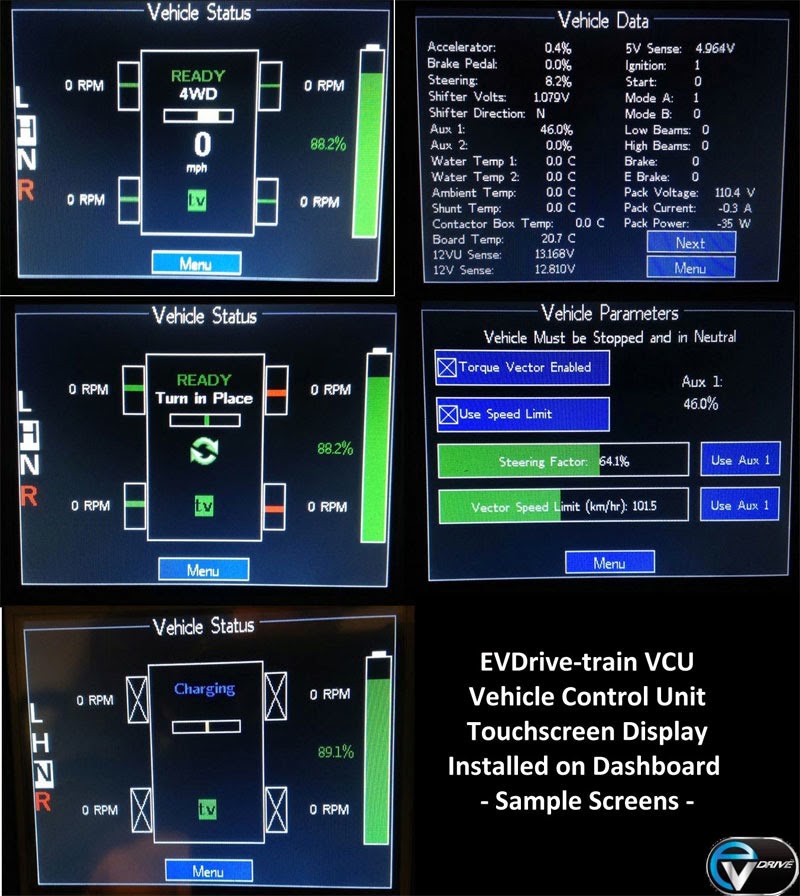
In the accompanying video to this press release, some of the e-UTV tech demonstrator more technical features are revealed, such as: control touch screen for the Terra-Torque-Drive™, specifically the interface to the in-house developed VCU, shown in accompanying picture links below, and optional engine sound synthesis unit some OEMs expressed interest in, with 2 sounds demonstrated in the video, a gas turbine and V-twin motorcycle sound.

Addition of the15kW REX not only gives the UTV full performance and range to match and exceed top UTVs on the market but also offers a feature the competition does not, that is 120vac of electrical power anywhere you need it. "With the REX sub-system part of the Terra-Torque-Drive™, a hybrid UTV can be a true swiss-army-knife UTV, able to deliver power in remote locations for construction/utility/ranch applications, run silent for hunting/wildlife observation & with full-time 4wd torque vectoring, can deliver off-road handling and performance for sports/recreation, in summary, addressing all needs in the consumer, prosumer and commercial markets," said CEO, Steve Tice.

"Similar to our 25kW REX technology installed in our Series-PHEV BMW325 tech testbed -> http://bit.ly/PHEV-BMW-3-series but smaller, our custom high voltage 15kW-single cylinder (ICE) powered REX for the UTV is located between the rear seats – so with this sub-system, competing against top 4-seat UTVs in range will not be a problem - certainly the performance meets and beats stock UTVs we have tested" said EVDrive's CTO Bob Simpson. The REX gas engine can be modified to run on LPG as well offering additional emissions and operational cost advantages. EVDrive's REX technology supporting the hybrid e-UTV development has been already designed & proven in EVDrive Series PHEV BMW 325i Technology Testbed here shown sealed below rear spare tire floor - no protrusion above stock floor as shown in pictures at link included above.

EV West is partnering with EVDrive to deploy and demonstrate Terra-Digital-Torque-Steer™ all-wheel torque vectoring technology on full-size off-road vehicles. EV West is known for many milestones; e.g. Builders and drivers of the record breaking all-electric BMW 3-series street sedan at the Pikes Peak International Hill climb and builders of first ever electric off-road race car to run the Baja Mexican 1000 race in the National Off Road Racing Association's series.

Blog, Updated at: 5:58 PM

Nissan "seriously testing” wheel motor powered 380Z like EV sports car

We reported almost a year ago that Nissan were “really seriously testing” in-wheel electric motors for the new-generation of electric-powered cars. The automaker's global design chief Shiro Nakamura has again confirmed this during an interview with Motor Authority at the recent Detroit Auto Show.

“It's not just at the concept level...We are making serious progress with in-wheel motors; cost is becoming less of an issue, and at a certain point we would like to use in-wheel motors.”

While Nissan's BladeGlider EV concept has in-wheel motors on the rear axle, Nakamura admitted that Bladeglider has some design attributes (like its narrow front track) that might prove insurmountable for a global product—especially with respect to safety—and that any production car would likely have to be wider in front.

He suggests the ESFLOW EV concept, which from behind looks alot like the Bladegliber and at first glance could easily be mistaken for a 380Z, could be a production direction.

The ESFLOW concept presented at the 2011 Geneva Motor Show was said to have a cruising range on one charge of 240 kilometer (150 mile) and was rear-wheel drive powered by two motors that where placed above the axis of the rear wheels, in a mid-ship position.

These motors independently control the left and right wheels, and so the torque is optimized to ensure outstanding vehicle stability and control as well as efficient power regeneration. The motors produce enough torque in an instant for the ESFLOW to reach 100 kph in under 5 seconds.

Blog, Updated at: 4:41 PM

SIM-Drive develop 4 motor AWD electric Toyota 86 [VIDEO]

The EV SIM-86e, a Toyota 86 developed by SIM-DRIVE, was exhibited at the Odaiba Motor Fes. The car is an 86 based EV, with all 4 wheels powered by independent motors.

Technical specifications haven't been released (in English at least) but we can make some educated guesses. The AWD EVs developed by SIM-Drive to date, SIM-Lei, SIM-Wil & SIM-Cel have all used direct drive in-wheel motors. We can see from the picture below (click on image to enlarge), the standard friction brakes are visible in the wheels so the SIM-86e must be running in-board motors.

In developing the SIM-86e, Tajima Motor Corporation used E-RUNNER technology, which the company has been developing for racing vehicles to participate in the Pikes Peak International Hillclimb. TMC Chairman of the Board and SIM-Drive President and Director Nobuhiro Tajima explained:

“Since our development of a 4WD automobile with a twin engine, we have been playing with such car-control technology as multiple power sources and 4 independent motors. In the SIM-86e we have thoroughly employed the control know-how cultivated through developments to E-RUNNER technology.”

While the Pikes Peak winning E-RUNNER was all-wheel-drive, it used only two motors driving the wheels through a differential on each axle. The motors were supplied by GKN and belived to be 2x AFM-240 motors, each capable of 335 kw (455 hp) and 1200 Nm Peak. As the GKN Evo motors are not suitable for in-wheel mounting we might speculate that the SIM-86e may be running 4x in-board AFM-140 motors driving the wheels via standard half-shafts, with or without gear reduction. The original SIM-Drive wheel motors were outer-rotor (drum brake type) radial flux BLDC motors (see SIM-Cel motor below) while GKN Evo's are axial flux (disc type) motors.

“This year there were some wet roads, and for that reason our times didn't improve. However, with next year’s dry conditions, I think it may be possible to achieve a new course record. Also, our efforts for next year’s car are making it compatible with a fast charger, meaning we will get technological feed back for product version EVs as well. Both for practical reasons and in times of crises, EV’s clearly need to have the ability to charge quickly. I’m confident that fast charging technology for harsh motor sports conditions will be useful for developing the product versions to come.”

Blog, Updated at: 2:43 PM

Protean & FAW-VW China to Develop RWD In-Wheel Motor System

Protean Electric has announces a partnership with FAW-VOLKSWAGEN (China) to develop an all new electric propulsion system that will include Protean Electric's in-wheel motors with intent towards a demonstration vehicle program and production.

FAW-VW will create an all-new rear-wheel drivetrain for a pure Electric Vehicle (EV) based on the new Bora compact sedan, utilizing two Protean in-wheel motors. This cooperation began several months ago and so all bench testing, engineering calibration and on site application support is expected to be completed within a year. Protean Electric will also assist FAW-VW in the development of safety and vehicle controls that can be applied to additional vehicle programs.

Protean raised $84 Million in VC funding last year and moved their operation to Liyang, Jiangsu Province, China.

"Protean Electric is very pleased and honored to be working with FAW-VW. Our involvement with this prestigious automaker shows that Protean Electric is continuing to serve as a valuable resource for OEMs as they develop New Energy Vehicle programs," says Kwok-yin Chan, CEO of Protean Holdings Corp. "This is a two-phase project that will capitalize on the torque and packaging freedoms that Protean Drive™ can bring to an automaker. Our technology will return the space to the new Bora vehicle platform that was formerly occupied by an in-board motor and powertrain."

Like the recently revealed Schaeffler Ford Fiesta eWheelDrive prototype, the Protean powertrain will be rear-wheel-drive only. One of the main reasons many in-wheel motor prototypes demonstrated to-date have only been used on the rear axle is due to front steering geometry. Most FWD cars use negative scrub radius to prevent torque steer. Due to their outer dimensions, many ‘drum brake type’ wheel motors adversely affect the scrub radius so are simply unsuitable for FWD operation.

Blog, Updated at: 7:02 PM

Zoox Reveal Autonomous Bi-directional Electric Vehicle Concept

Meet The Boz; it's not really a car - it's what might come after the car - a vehicle design based entirely around autonomous driving.

Inside the Boz, the experience would be like sitting in a train. Drivers become passengers, or "commanders." Without needing to focus on traffic and road signs, they would be able to use the commute to do some work or watch a video or have a snooze!

Just as the internal combustion engine enabled the car to replace the carriage, Zoox believe autonomous technology will replace the car, and in doing so create a new class of mobility known as 'Level 4'.

Level 4 is a term taken from a policy statement the US National Highway Traffic Safety Administration released on May 30, 2013. This document outlines a spectrum of mobility systems from the fully manual Level 0, through to Level 4 which is fully autonomous.

From a design perspective, the first element you may notice is what's absent: the front and rear windshield. This is not to say L4s can't have them — certainly those designed for tourism would — but this vehicle makes the statement that you now have an option.

Firstly, it gains thermal, aerodynamic and acoustic efficiencies. The thermal load lost through the windshield is significant, requiring energy intensive climate control systems, as well as a number of ancillary systems to keep the glass clear. These inefficiencies are removed.

The entry profile of the vehicle is aerodynamic as a near teardrop, unattainable in a car due to the requirement for driver vision. The low profile roofline and absence of glass further lends itself to superior acoustic insulation. The side windows are thin, but double glazed, which enhances these properties.

Because the requirement for the passenger to be situationally aware of their exterior environment is removed, external sound and light can be shielded to enhance a sense of serenity and safety. This is a superior environment for interacting with voice-activated systems, watching video or conversing.

You can be in the middle of a bustling city, but when the door seals, you are in your own world.

The Boz has all-wheel active suspension, all-wheel steering and all-wheel drive, all optimized by Artificial Intelligence. All-wheel drive means the torque applied to each in-wheel motor can be precisely regulated, delivering the benefits of anti-lock braking and electronic stability control without the need for ancillary systems. The electric motors, which are equally capable of spinning in either direction, also facilitate regenerative braking.

While driverless cars sound fantastic, a driverless ULTra PRT pod transport system with 21 pods and over 4km of track has been operational at London Heathrow airport since May 2011 and a larger scale trial of 100 pods will begin in 2015 in Milton Keynes.

Source: Zoox

Blog, Updated at: 12:32 AM

Nissan BladeGlider Wheel Motor Powered EV Concept [VIDEO]

More than a concept, Nissan BladeGlider is both a proposal for the future direction of Nissan electric vehicle (EV) development and an exploratory prototype of an upcoming production vehicle from the world's leading EV manufacturer. BladeGlider was developed with form following function. Nissan crafted the vehicle's unique architecture to give the driver and passengers "sustainable exhilaration" - a fresh electric vehicle driving experience based on peerless technology and exotic styling.

Targeting the visionary individual seeking visceral driving and sustainability, BladeGlider goes beyond sheer power and acceleration to send the heart soaring into new realms of smooth "gliding" pleasure. It is a physical demonstration of the innovation and excitement of the Nissan brand and Nissan's Zero Emissions Mobility leadership. BladeGlider's pioneering spirit distinguishes it from anything yet envisioned for EVs and destines it to rule the roads of the not-so-distant future.

Re-inventing the Performance Car - A Game Changer Designed from Scratch

A clean slate was the starting point for this project, led by Francois Bancon, division general manager of Product Strategy and Product Planning at Nissan. "The goal was to revolutionise the architecture of the vehicle to provoke new emotions, provide new value and make visible for consumers how Zero Emissions can help redefine our conception of vehicle basics," said Bancon.

BladeGlider's shape alone, with its narrow front track, challenges the orthodoxy that has dominated the roads since the earliest days of the internal combustion engine. The revolutionary nature of the car is more than skin deep. New possibilities for the designers and engineers were opened up by the unique characteristics of electric vehicles.

BladeGlider has its conceptual roots in two aerial images: the soaring, silent, panoramic freedom of a glider and the triangular shape of a high performance "swept wing" aircraft.

It is therefore fitting that, in terms of engineering, BladeGlider's developmental focus was aerodynamics: achieving low drag (cdA) while generating road-hugging downforce.

Disruptive and challenging to the status quo, BladeGlider shares sustainable engineering values with both Nissan LEAF - the best-selling EV in history ─and the Nissan ZEOD RC (Zero Emission On Demand Racing Car), which will make its debut at next year's Le Mans 24 Hour race.

A Provocative Shift in the Engineering Paradigm

With its narrow, 1.0 metre lightweight front track and wide, stable rear track, BladeGlider looks as if it could have sprung from a "skunk works" project. But the radical architecture all boils down to aerodynamics and balance. Having the front wheels close together reduces drag and enhances manoeuvrability for high-G cornering power, assisted by its 30/70 front/rear weight distribution ratio. Aerodynamic downforce is created by the highly rigid yet lightweight carbon-fibre underbody, hence the lack of drag-inducing wings.

When BladeGlider matures into a production car, it could be Nissan's first use of in-wheel motors. The in-wheel motors provide rear-wheel propulsion with independent motor management, while also contributing to freedom of upper body design and space-efficient packaging.

To power the electric motors, BladeGlider employs Nissan's innovative lithium-ion battery technology, proven in Nissan LEAF. Battery modules are mounted low and towards the rear to enhance stability and handling.

Revolutionary Breakthrough in High-Performance Design

BladeGlider embodies a fearless vision of the EV future. Its tightly streamlined deltoid body comprises a tough and structurally optimised chassis wrapped in ultra-lightweight, yet strong and stiff, carbon fibre reinforced plastic (CFRP) finished in a pearlescent white colour that evokes the pristine freedom of a glider. The racing-inspired exterior features a sculpted contour that is both functional and breathtakingly beautiful. Starting from the low, flat and narrow nose, the body line rises gracefully to the cockpit canopy and then curves forcefully back over the large rear wheels, evoking a sense of dynamic movement even when the vehicle is standing still.

"BladeGlider was conceived around delivering a glider-like exhilaration that echoes its lightweight, downsized hyper-efficient aerodynamic form," said Shiro Nakamura, Nissan's senior vice president and chief creative officer. "This design is more than revolutionary; it's transformational, applying our most advanced electric drive-train technology and racetrack-inspired styling in the service of a new dimension of shared driving pleasure."

Inside the canopy, the cockpit seats three in a triangular configuration with the driver centre-forward. Seating appointments feature special light and comfortable coverings with yellow fluorescent lines. Amid simple yet edgy interior styling cues, an aircraft-type steering wheel and state-of-the-art instrumentation technology complete the glider-like image. To support maximum EV cruising efficiency, the IT system can display relief maps and atmospheric conditions.

This efficient, aerodynamic, simple, and lightweight vehicle provides a "gliding" feel that combines the feeling of gravity-defying freedom and near-360 degree view of a glider with the pulse-quickening exhilaration of a race car.

"I think that the excitement of the racing car should be mirrored in the excitement of driving the road car," said Ben Bowlby, director of Nissan Motorsport Innovation, who has supported the BladeGlider's development. "I think there are elements we can bring from the race track to make these future road cars more exciting, more fulfilling and give greater driving pleasure."

As a rear-drive performance car, BladeGlider exhibits a coherent and linear handling that enables it to consistently hug road curves, providing feedback for intuitive and exhilarating steering control when cornering under threshold conditions.

Augmenting BladeGlider's aerodynamically-engineered precise feedback and control, the canopy-like visibility of the driving position engenders a synchronised feeling of oneness with the machine and the road. The result is a free soaring experience which the driver can share with two passengers in the V-shaped seating configuration. Passengers sit at the longitudinal centre of gravity to maintain the car's balance at all times. The centre-driving setting of the cabin space is designed to enhance the driver's sensatory experience. 

As a final touch, the driver's seat automatically slides laterally when you open the door, enabling easy access to passenger seats.

New EV Values for the Next Generation

By thinking outside the box, Nissan has created an EV that truly symbolises the unlimited potential of electric propulsion - balancing zero emissions with innovative excitement like never before.

Blog, Updated at: 3:53 PM

Dutch Students Break EV Acceleration Record 0-100 km/h in 2.13 sec [VIDEO]

Dutch students today reset the Guiness world record for acceleration 0-100 km/h, in the category for electric cars. The Delft University of Technology Racing Team used their 2012 All-Wheel-Drive 148 kg Formula Student DUT12 to accelerate from zero to 100 km/h in just 2.13 seconds at Valkenburg Airport.

The Formula SAE car has a four wheel drive powertrain with a 26 kw / 27 Nm motor driving each wheel giving a total peak power output of 104 kw. The front motors are out-board and drive through a 1:7 Planetary gear system. The rear motors are in-board and drive the wheels via a 1:13 two-stage spur gear system with carbon fiber half-shafts.

The Delft Team first prepared the ground by pouring a solution of sugar in water over the track, and heating it with a gas-burner. All rubble was removed and a plastic sheet was put over the track to keep it dry. Additionally, tire warmers were used on the car, the driver was the team's lightest member, Marly Kuijpers, and the the run was repeated ten times with traction control and tire slippage tweaked for each run within the four motor controllers via the CAN bus ECU.

The team says that rule changes make 2013 and 2014 Formula Student cars less likely contenders for future acceleration records. For one thing they will have high downforce wings, which add drag, and larger batteries, adding weight. The heavier machines are unlikely to reach a new record, so Delft may well hang on to the top spot longer than another student team, which held its record just over a year.

Blog, Updated at: 4:08 AM

UNSW Sunswift launch 140 km/h “eVe” Cruiser Class Solar Racecar

UNSW Solar Racing Team Sunswift revealed their solar racing car eVe at the University of New South Wales last Friday.

The latest addition to the Sunswift family is designed for the new Cruiser class, which consists of four-wheeled vehicles that must meet regulations for normal roads-worthy vehicles in the country they come from. They’re also required to have both a driver and a passenger.

The new Sunswift racer is RWD and powered by 2x 1.8 Kw (10 Kw Peak) Australian developed direct drive CSIRO wheel motors, now manufactured under license by Marand Precision Engineering, giving a top speed of 140 km/h. 15 kWh worth of Panasonic cylindrical Lithium Ion batteries, weighing only 63 Kg, output 140 volts and give eVe a single charge highway speed cruising range of over 500 km, as much as the 85 kWh Tesla Model S!

This incredible range is achieved by a combination of light weight (about 300kg) carbon fiber monocoque construction, extremely low drag coefficient, 98.3% energy efficient direct drive wheel motors and solar charging. Battery charge comes care of continuous top-up from the PV cells, with opportunities for major fills from the grid at points in Tennant Creek, Alice and Coober Pedy.

eVe has a 1800 x 4500 mm footprint (larger than a Tesla Roadster) with four square metres (WSC rules allow up to six square metres) of Mono-crystalline silicon cells provided by SunPower.

Although the new car has twice the frontal area of its blade-like predecessor, Sunswift has achieved a similar drag coefficient. It’s managed this partly by the use of a smaller PV cell area, and partly through a unique high-set “tunnel” underside design, giving the car the look of a catamaran.

For the carbon fibre bodywork, Core Builders Composites in New Zealand, best known for its work on maxi-yachts of the calibre of Oracle’s America's Cup ocean racers, offered the team a sponsorship deal. The result is a structure of immense strength, with the only metal component a steel roll bar, there for compliance with FIA motorsport standards.

The team is looking towards a hi-powered version of the car using motors on all four wheels although to do so the team say the battery would need a significant upgrade.

The Bridgestone World Solar Challenge starts on October 6th in Darwin and finishes 3,000 km later on Sunday 13th October in Adelaide.

Disclosure: Post is sponsored by Bridgestone World Solar Challenge. Words and thoughts are entirely my own.

Blog, Updated at: 4:55 AM
Copyright © 2014. Interior Designs - All Rights Reserved
Template by seocips.com
Template Published by template.areasatu.com
Powered by A1
Back to top